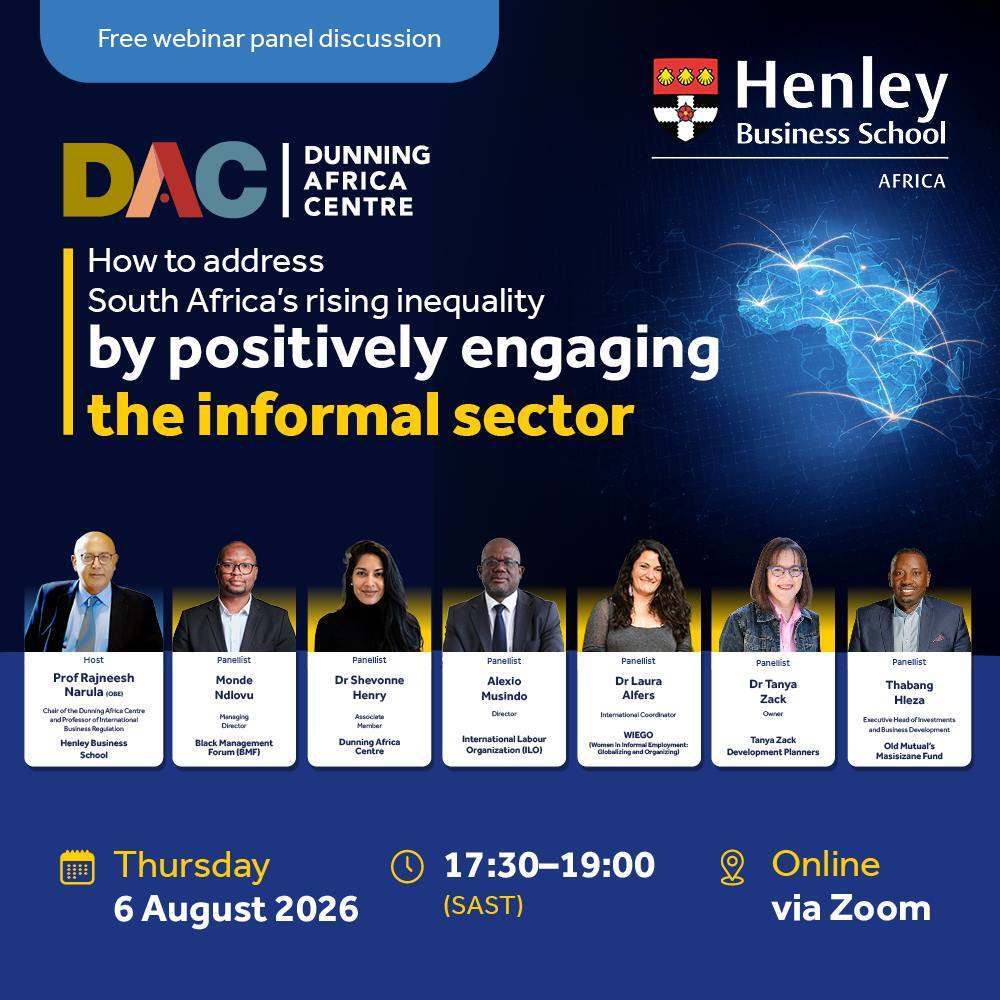
More than 20% of South Africans earn a living in the informal economy. Yet most operate survivalist businesses that generate little income and even less opportunity for growth. After three decades of government and civil society interventions, the sector still contributes only 6% of GDP. Why has South Africa failed to build a more productive informal economy, and what should happen next?
In this webinar, host Professor Rajneesh Narula (OBE) brings together an accomplished panel of experts to unpack:
-
Why South Africa's informal economy has struggled to become a meaningful driver of inclusive growth and reduced inequality
-
The role of informal and indigenous economies in creating livelihoods, dignity and economic participation
-
How policy, institutions and business can better support informal workers and micro-enterprises.
-
Practical pathways to building a more inclusive economy that expands opportunity, decent work and shared prosperity.
Event information
Date: Thursday 6 August 2026
Time: 17:30–19:00 (SAST)
Venue: Online via Zoom
Cost: Free
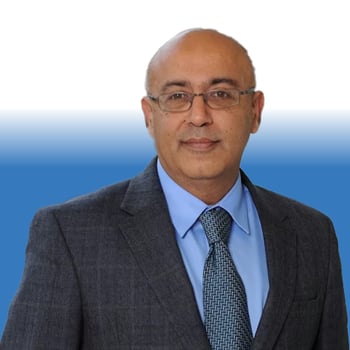
MEET YOUR HOST
Professor Rajneesh Narula (OBE)
Prof Rajneesh Narula (OBE) Chair of the Dunning Africa Centre and Professor of International Business Regulation at Henley Business School
Meet the panellists:
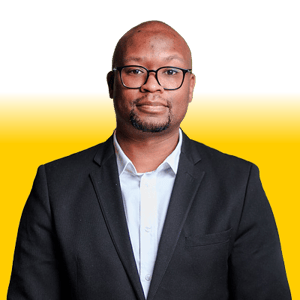
Monde Ndlovu is a strategic thinker and policy advocate focused on economic transformation and inclusive leadership. As managing director of the Black Management Forum, he plays a key role in advancing black leadership and systemic change in South Africa's corporate landscape.
Ndlovu is a prolific writer and commentator, contributing to national discourse on youth empowerment, economic justice, and leadership development. His extensive work in organisational strategy, stakeholder engagement, and governance reflects his commitment to resharing economic structures for greater equality and sustainable growth.
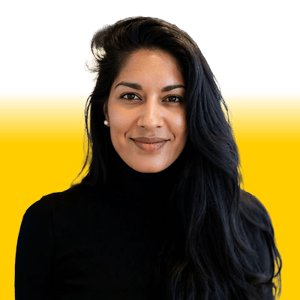
Dr Shevonne Henry is an associate member of the Dunning Africa Centre at Henley Business School Africa. She is a former diplomat and community journalist and holds a PhD in Sociology from the University of Leicester, an MSc in Sustainable Development from SOAS University of London, an Advanced Diploma in Diplomacy from the Diplomatic Academy of South Africa, and a BA in International Relations and Diplomacy from the University of South Africa. Dr Henry’s research centres on informal and indigenous economies in Southern Africa and Southeast Asia.

Dr Laura Alfers is the international coordinator of WIEGO (Women in Informal Employment: Globalizing and Organizing). Originally from South Africa and now based in the United Kingdom, she has spent more than 15 years working alongside organisations of informal workers across the Global South.
Her work focuses on social protection, labour rights, climate resilience, and inclusive economic development. She is particularly interested in how worker organisation and collective action can help build more equitable and sustainable economies in Africa and beyond.

Dr Tanya Zack is a South African writer, urban planner, and researcher whose work focuses on urban regeneration, contemporary migration, informal work, urban policy, and affordable housing in Global South cities. She has undertaken groundbreaking research into cross-border shopping in inner-city Johannesburg and taken a role in inner-city transformation and housing policy formulation.
Her writing (The chaos precinct: Johannesburg as a port city; and Wake up, this is Joburg) has set the bar for South African non-fiction and been longlisted for the Sunday Times Literary Award. Dr Zack is affiliated with the University of the Witwatersrand’s School of Architecture and Planning.

Thabang Hleza is the executive head of Investments and Business Development at Old Mutual’s Masisizane Fund. He previously held various roles in development finance and private equity, where he was responsible for the strategic, operational, and financial performance of several portfolios. He also boasts experience in post-investment due diligence, deal structuring, and implementing value creation opportunities within portfolio companies.
With his passion and experience working with small and medium-sized enterprises (SMEs), Thabang is committed to strengthening their capacity for sustainable growth and lasting impact. He holds a BCom in Accounting from the University of Cape Town and an MBA from the University of Pretoria.
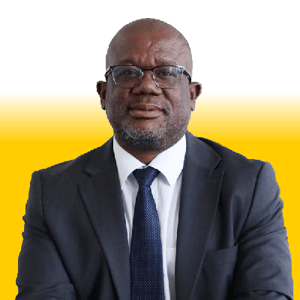
Alexio Musindo has over 25 years’ experience in international development across Africa. Before assuming his role as the International Labour Organization (ILO) director for Country Office – Botswana, Eswatini, Lesotho, and South Africa, and Decent Work Team for Eastern and Southern Africa, Musindo held several leadership positions in the ILO, including representative in Ethiopia, Djibouti, Somalia, Sudan, and South Sudan; ILO Country Director for Zambia, Malawi, and Mozambique; and ILO director for East Africa. He embarked on his United Nations career as a programme officer in 1998 at the ILO Regional Office for Africa in Abidjan, Ivory Coast.